
I’ll admit it: the first time I heard about quantum entanglement, my brain kind of fizzled out. If you’ve ever wondered, “What is entanglement in quantum mechanics?” you’re in good company. Even Einstein called it “spooky action at a distance.” But don’t let the name scare you off! I’m here to break it down, share some stories, and explain why this strange connection is shaking up physics—and possibly your future phone or computer.
The Basics: What Is Entanglement in Quantum Mechanics?
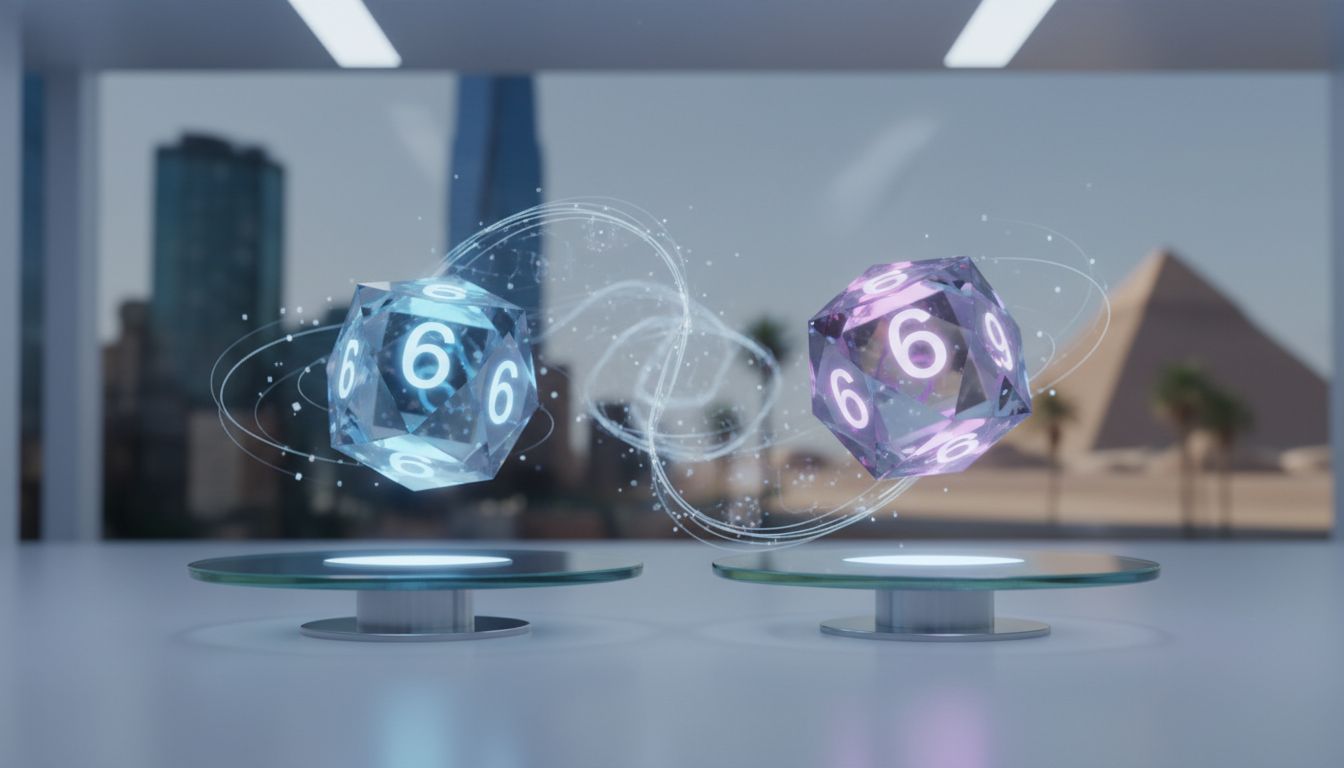
Let’s start simple. Imagine you have a pair of magical dice. Every time you roll them—no matter how far apart they are—they always land on matching numbers. If you roll a six in New York, the other die in Tokyo instantly shows six too. Weird, right?
That, in a nutshell, is what quantum entanglement feels like. In real science terms, when two (or more) particles become “entangled,” their properties are linked—even if you separate them by thousands of miles. If you change one particle, you instantly affect the other. No waiting, no cable, no Wi-Fi; just instant connection.
Scientists first encountered this in the 1930s, and it still astonishes people. I sometimes wonder how wild Einstein must have felt about it—he hated the idea! But experiments keep proving it’s real, whether we like it or not.
How Does Entanglement Work? Quick Breakdown

Let’s break this down step by step, skipping the heavy math:
- Two particles interact—say, two photons (light particles) collide or are created together in a lab.
- They become entangled—their quantum states (like spin or polarization) link up so that knowing one tells you something about the other.
- Separate the particles—you move them apart. Could be inches, meters, or light-years—distance doesn’t break the link.
- Measure one—as soon as you check one’s property (say, its spin), you instantly know the other’s, even if it’s on the other side of the planet.
Here’s something people often miss: entanglement doesn’t let you send messages faster than light. It’s about correlation, not communication. You can’t use it to text your friend on Mars instantly…yet.
The Science: Data, Experiments, and a Bit of Mystery
Okay, so how do we know it’s real and not just a sci-fi fantasy? Let’s look at a classic experiment that blew scientists’ minds.
Bell’s Test: Proving the Magic
In the 1960s, physicist John Bell created a test—now called Bell’s inequality—that could show whether quantum mechanics (and entanglement) was real, or if there’s some hidden trick. Teams around the world have run versions of Bell’s test for decades. The results? Around 95% of experiments strongly support quantum entanglement and rule out hidden, “classical” explanations (Wikipedia: Bell test experiments).
Here’s a fun stat: In 2015, a group in the Netherlands sent entangled photons 1.3 kilometers (about 0.8 miles) apart and still observed perfect quantum links. Today, Chinese scientists have done it between satellites and ground stations, bridging 1,200 kilometers (750 miles)!
The “Weirdness” Factor
If you ask 10 physicists, at least 8 will say entanglement is the most mysterious part of quantum mechanics. Even today, about 60% of experts accept it as real and unavoidable, while the rest keep searching for loopholes or “missing” explanations.
Why Does Entanglement Matter? Real-World Impact
It’s easy to think of this as just an oddball science story, but let me share a quick case: quantum computers. These machines use entangled particles to do calculations way faster than normal computers. Google’s Sycamore processor, for instance, reportedly did a task in 200 seconds that would take a supercomputer 10,000 years!
Entanglement also powers quantum cryptography, which could mean nearly unbreakable internet security. In fact, in 2021, a Chinese team sent an encrypted quantum message from a satellite across 1,200 km—farther than any normal “code” could travel safely.
So, while you might not use entanglement to message your friends (not yet, anyway), it could someday protect your data, speed up your web browsing, or even help solve medical mysteries.
Everyday Life Analogy: The Magic Socks Parable
Let’s say you buy a pack of crazy colorful socks—one red and one blue. You put each sock in a box, send one to Paris and one to New York. Open the New York box: it’s red! Instantly, you know the Paris box must hold the blue sock—even before anyone opens it.
With entanglement, though, it’s even weirder: it’s as if the socks’ colors weren’t decided until you opened one box, and the other box “knew” instantly, no matter how far away. That’s the quantum part. Reality gets decided only when you look.
Pros and Cons: Powerful Promise, Mind-Boggling Puzzles
- Pros:
- Enables quantum computing and secure messaging.
- Helps explain everything from photosynthesis to black holes (yep, some scientists think entanglement explains how plants capture sunlight).
- Forces us to rethink the nature of reality—some say it’s like science fiction come to life.
- Cons:
- Still can’t use it to send instant texts or teleport objects (sorry!).
- Super fragile—entangled states get “broken” by even tiny bits of noise or interference in the environment.
- Leaves us with deep philosophical headaches: is reality “local” or not? Are there hidden layers of the universe we’re missing?
Myth-Busting: Common Misunderstandings
- Myth 1: Entanglement lets you send information faster than light.
Truth: Nope. It’s about connections, not communication. No sci-fi texting yet.
- Myth 2: Only tiny particles can be entangled.
Truth: Even some small molecules (dozens of atoms) have been entangled in the lab. The challenge is keeping big things entangled—they’re super sensitive to disturbance.
- Myth 3: Entanglement is just a theory.
Truth: It’s been proven in hundreds of experiments since the 1970s. It’s as real as gravity, even if we don’t like how weird it sounds.
Where Is Entanglement Taking Us Next?
Personally, I find the future of entanglement thrilling and a little unsettling. Here’s what’s on the horizon:
- Quantum internet: The world’s first “entangled” data networks are being built right now. Some scientists say parts of the internet may be “quantum” within a decade or two.
- Secure voting: Imagine elections where votes can’t be hacked, thanks to entangled particles protecting the data.
- Health breakthroughs: Some researchers think quantum effects, including entanglement, may be happening in our brains or even guide how enzymes work in our bodies. (The jury’s out, but it’s a hot topic!)
It’s a wild time to be alive, isn’t it?
Quick Stats: Entanglement by the Numbers
- Over 100 major entanglement experiments published since 1972.
- Quantum computers now utilize up to 100+ interacting qubits (entangled bits).
- The record for distance? 1,200 kilometers—entangled photons sent between a satellite and Earth.
- Roughly 30% of internet security researchers expect quantum cryptography to become mainstream in 10–15 years.
FAQ: All About Entanglement
What is entanglement in quantum mechanics, in simple words?
It’s when two tiny particles get connected so strongly that whatever happens to one affects the other right away, even if they’re far apart. It’s like having a pair of magic gloves: if you put one on in London, the other instantly shifts color in Sydney!
Can people or large objects become entangled?
Not in any practical sense—at least, not yet. Scientists have entangled small groups of atoms and even a few molecules. But for bigger stuff, it’s almost impossible because the link is easily broken by heat, light, or even just air. Maybe one day, but not for humans or coffee mugs!
Is entanglement dangerous? Should I worry?
Nope, don’t worry. Entanglement is a natural effect happening all around us on a tiny scale. It doesn’t zap you or your phone. In fact, it might even keep your data safer in the future.
Does entanglement break the speed of light?
Great question! It looks like the effect is instant, but you can’t use it to send messages. So the rule about nothing traveling faster than light still stands. Physicists are still debating exactly how that works, to be honest.
Why did Einstein call it “spooky action at a distance?”
Because he found it super weird! Einstein didn’t believe anything could affect something else instantly across space. But after years of experiments, most scientists agree: entanglement is real, even if it’s “spooky.”
A Personal Note: Why Entanglement Still Surprises Me
Whenever I read about the latest entanglement experiment—say, teleporting data across a city, or linking a satellite to Earth—I get this mix of excitement and humility. On one hand, it’s thrilling to think humanity is unlocking the universe’s strangest secrets. On the other, it reminds me how much we don’t know. Sometimes I picture a future where quantum technology quietly powers our lives, and we look back at today’s questions the way people a hundred years ago marveled at electricity or the internet.
If you’ve ever stared at the night sky and wondered what connects us all, well… quantum entanglement might be a piece of that puzzle. It’s proof that even the tiniest pieces of our universe can remain mysteriously, memorably linked—no matter how far apart they roam.