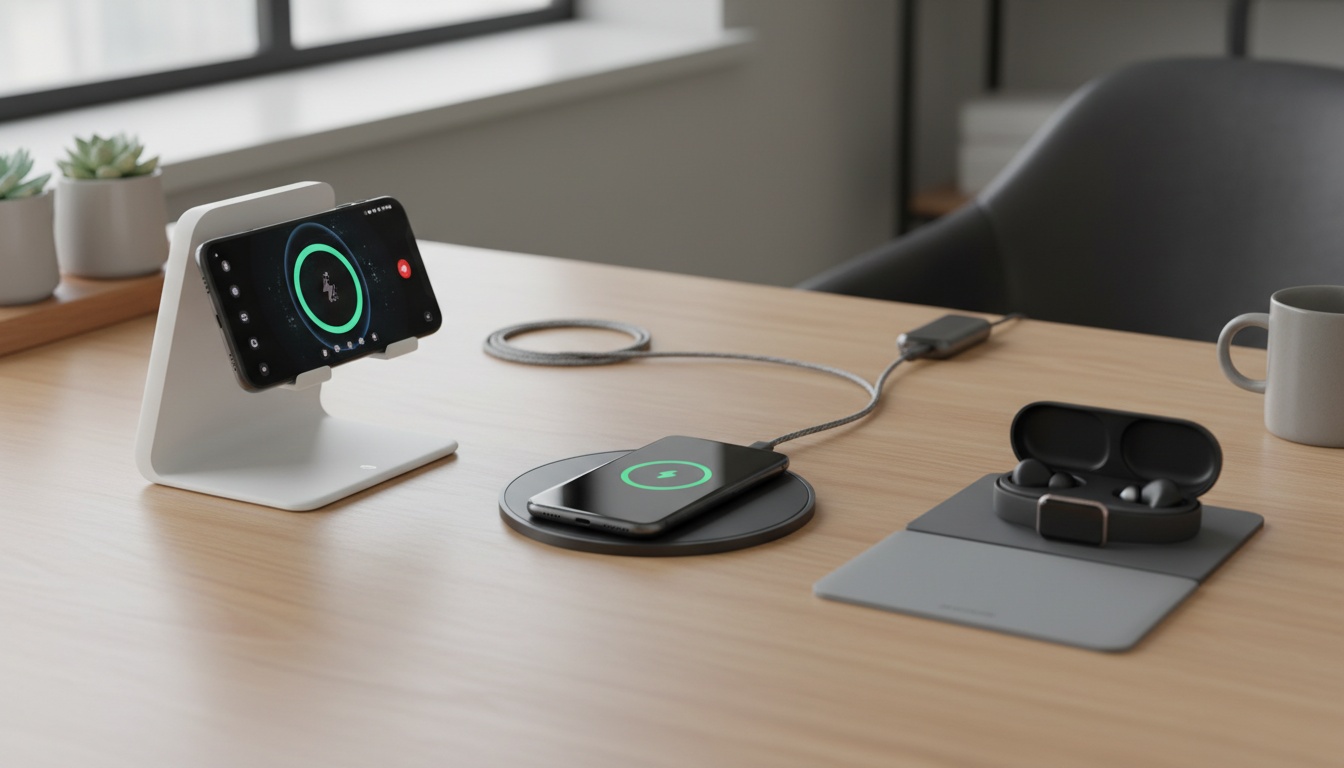
So, wireless chargers. The promise: you drop your phone on a pad (maybe with a tired sigh after a long day), and—like magic—it charges, no fumbling with cables. But are all wireless chargers created equal? And which ones truly deserve to be called the best wireless chargers? If you’ve ever wondered why one charger takes ages while another fills your battery before you finish your cereal, you’re not alone. Let’s dive in, clear up the charging fog, and figure out what actually matters.
First Things First: How Do Wireless Chargers Even Work?
Let’s keep it simple. Wireless chargers use something called Qi (pronounced “chee”) technology. It’s basically a fancy way of saying “wireless energy transfer.” Inside your phone and the charger, there are tiny coils. When you put your phone on the pad, those coils create an invisible magnetic field, and boom—energy hops from the charger to your battery. Honestly, it feels a bit like sci-fi, but this is real, everyday tech.
Here’s the catch: not all devices charge at the same speed or with the same efficiency. Some phones—like the latest iPhones or Samsung Galaxy models—can handle faster wireless charging (15W to 20W), while cheaper or older phones might peak at 5W or 7.5W. That’s a big gap. And the charger you buy makes a difference, too.
What Actually Makes a Wireless Charger “The Best”?
- Speed: Charging wattage (5W vs. 15W, etc.) really matters. Faster isn’t always better if your phone can’t handle it, though.
- Compatibility: Does it work with your phone, earbuds, maybe even your smartwatch?
- Design: Is it a flat pad, a stand, or a multi-device station? Will it slide around on your desk, or does it stay put?
- Safety: Overheating and overcharging protection is not just marketing jargon—you want it.
- Extras: Think about things like LED indicators, foreign object detection, or even just how the charger feels in your hand.
I sometimes wonder if people actually use those multi-device stations or if they’re just Instagram bait. But honestly, for families (or tech-heads with a phone, earbuds, and a watch), a good charging station can be a lifesaver.
Quick Comparison: Stand vs. Pad vs. Multi-Device
- Flat pads are the classic choice—just drop your phone and go. But they’re a bit finicky; if you don’t line things up right, nothing happens. (Ask me how many times I’ve woken up to a dead phone.)
- Charging stands prop up your phone, so you can see notifications and FaceTime while charging. Great for a desk or nightstand.
- Multi-device stations are for folks with lots of gadgets—airpods, smartwatch, and phone. But cheaper ones can be unreliable, especially for Apple Watches.
In a 2023 survey, about 62% of wireless charger buyers picked stands or multi-device setups over flat pads. The reason? Convenience and fewer missed charges.
Top Features to Watch For (A Little Data Never Hurts)
Here’s something people often miss: a 15W charger won’t magically make your 7.5W iPhone charge faster. Your device decides the maximum speed. But the charger quality still matters—cheaper models sometimes can’t even hit their stated wattage. In tests by tech reviewers, off-brand chargers were up to 30% slower than name brands, even with the same watt rating.
- LED indicators: Super handy, but beware—some are so bright you’ll feel like you’re in a disco at 2am.
- Case compatibility: Most decent chargers work through cases up to 3mm thick. But metal or magnet-backed cases? Those can mess things up.
- Safety certifications: Look for “Qi-certified.” It’s not just a sticker—these chargers have to pass safety and efficiency tests.
Mini Case Study: Two Friends, Two Chargers
Let’s call them Max and Sara. Max buys a no-name $12 charger online. Sara springs for a $35 Anker stand. After a month, Max complains his phone barely charges overnight. Sara? She’s happy—her phone’s charged, her desk’s less cluttered, and the charger handles her AirPods, too. What’s the difference? Max’s charger overheats, charging slows, and sometimes it disconnects. Sara’s charger is better-built, certified, and yes, the higher price is actually justified.
It’s like buying a shirt. You can get one for $5, but it might fall apart after two washes. Sometimes, “cheap” is just, well, cheap.
Real-World Testing: What Reviewers and Users Actually Want
- Stable base: If your charger slides around every time you set your phone down, you’ll want to throw it across the room. Rubber feet or a weighted base fix this.
- Travel-friendliness: I once tried taking a large multi-device station on vacation—never again. If you travel, go compact and foldable.
- Brand reputation: Belkin, Anker, Mophie, and Samsung are the “safe” bets. Their chargers consistently get high ratings (4.4 stars or better on Amazon, for instance), and customer support is there if you need it.
- Noise: Cheaper chargers sometimes make a faint buzzing sound. Sounds minor, but next to your bed? Not so minor.
Here’s the pattern: the best wireless chargers don’t cut corners on basics. If there’s one thing I’ve learned, it’s that you notice what’s missing a lot more than what’s flashy.
Quick Picks: Some Best Wireless Chargers in 2024
Let’s break down a few real-world favorites. Not a “top 10” list—just honest picks that do their job, no nonsense.
-
Belkin 3-in-1 Wireless Charging Station
If you’re in the Apple ecosystem (iPhone, Apple Watch, AirPods), it’s hard to beat. Sleek, well-built, and actually charges everything at once. Pricey (around $120), but it just works. The downside? If you only have a phone, it’s overkill.
-
Anker 313 Wireless Charger (Stand)
Simple, affordable (under $25), and works with most cases. Charges iPhones at 7.5W, Samsungs up to 10W. The stand design is great for video calls or alarms, but if you want super-fast charging, you’ll need to pay more.
-
Samsung Super Fast Wireless Charger Pad
For Galaxy phones, this is a solid bet. Delivers up to 15W (if your phone supports it), and the pad stays cool. Downsides? The cable is a bit short, and it doesn’t work as well with thicker cases.
-
CHOETECH Dual Wireless Charger
Charge two phones (or a phone and earbuds) at once. Great for couples or roommates. About $35. The footprint is large, but it’s reliable and good value.
Why Go Wireless at All? (And When Wired Is Still Better)
Okay, honest moment: wireless charging isn’t always faster. Wired chargers—especially “fast charging” ones—can juice up modern phones two to three times quicker. Wireless is about convenience, not pure speed. For overnight charging, it’s perfect. For a quick top-up before rushing out the door? Plug it in.
According to a 2023 CNET roundup, most wireless chargers fill a modern phone from 0 to 80% in about 90–120 minutes, versus 40–60 minutes for a quality wired charger.
But once you get used to just plopping your phone down—no more cable hunting, no more fraying wires—it’s hard to go back. It’s a small joy you really notice on sleepy mornings or after a long day.
Charging Myths: Let’s Clear the Air
- “Wireless charging ruins your battery!” Modern chargers have safeguards to prevent overcharging. Battery wear happens over hundreds of cycles, no matter how you charge. Wireless isn’t worse; it’s just a bit slower.
- “Cases block wireless charging.” Most don’t. If you have a super-thick or metal case, then you might have issues.
- “All Qi chargers are equal.” Nope—power output, safety features, and build quality vary a lot.
How to Choose: Step-by-Step Logic for the Confused Shopper
- Check your device’s max wireless wattage. Find it in your phone’s specs or online. iPhones (since iPhone 8) can handle 7.5W; Samsung flagships do up to 15W.
- Decide if you want a pad, stand, or multi-device station. Where will it live? Desk, nightstand, or kitchen counter?
- Consider your case. If you use a bulky or magnetic case, look for “case-friendly” models.
- Stick to good brands. I know it’s tempting to save money, but remember Max’s story.
FAQ: All Your Wireless Charging Questions Answered
Will wireless charging work with my old phone?
Most recent phones (2017 and newer) support Qi wireless charging. If you’re not sure, check your phone’s specs or look up “[your phone model] wireless charging.” Some older models or budget phones might need a special receiver case, but those are rare these days.
Can I use the same wireless charger for my phone and earbuds?
If your earbuds (like AirPods, Galaxy Buds, Pixel Buds) have a wireless charging case, yes. Just place the case on the pad. Multi-device stations are made for this, but even regular pads usually work fine for both.
Is it safe to leave my phone on the charger overnight?
Yep. Modern chargers and phones have smarts built-in—they stop charging when the battery’s full. You won’t “overload” your battery. If anything, leaving your phone charging overnight is what most people do. Just avoid super-cheap, uncertified chargers for safety’s sake.
Do wireless chargers use a lot more electricity?
Not really. Wireless charging is a bit less efficient (about 70–80% efficiency versus 90% for wired), so you might see a tiny increase on your electric bill, but for a single device it’s pennies a month.
Why won’t my phone charge wirelessly sometimes?
It’s usually alignment—your phone’s coil and the charger’s coil need to line up. If you’re off-center, it might not charge. Also, thick or magnet-backed cases, metal objects (like keys), or a dirty pad can prevent charging. Try taking off the case or wiping the charger, and make sure nothing’s in the way.
Final Thoughts: The Human Side of Charging
I’ll admit, I once thought wireless charging was just a gimmick—until I tried it and realized how nice it is to never mess with cables. There’s something oddly satisfying about just dropping your phone down and walking away, even if it’s not as fast as plugging in. And the tech keeps improving: we’re now seeing wireless chargers that double as lamps or even blend into furniture. (Can we get one that makes coffee?)
At the end of the day, the best wireless chargers aren’t about bells and whistles. It’s about little upgrades that make your everyday routines smoother, less cluttered, and—let’s be honest—just a little bit cooler. Choose wisely, pay attention to the small details, and you’ll never go back to fumbling with cords in the dark again.