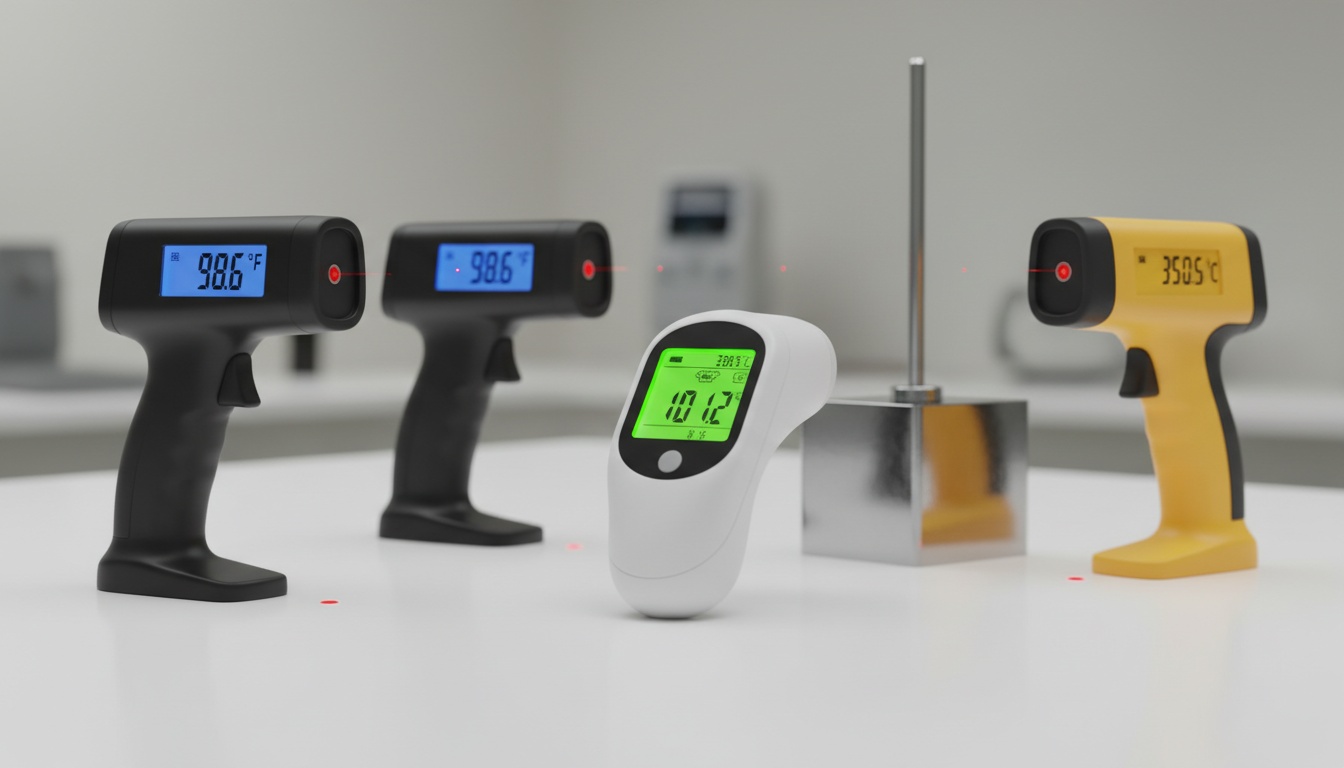
Let’s be honest: picking the best infrared thermometers isn’t just a “click and buy” decision anymore. There are so many models, so many claims—“ultra-accurate!” “fastest scan!”—that it’s easy to feel a little lost. I’ve tried a handful myself (between a fidgety toddler, a grumpy teenager, and way too many at-home science experiments), and what surprised me most was how much real difference there is behind those plastic shells.
So, what does “best” really mean here? Let’s dig in with a human lens: stories, stats, quirks, and a few eyebrow-raisers. By the end, you’ll know if you need a NASA-grade gadget or just a trusty fever-checker for Sunday night headaches.
Table of Contents
- How Infrared Thermometers Work (And Why It Matters)
- Real-Life Uses: Kitchens, Clinics, Classrooms, and Chaos
- Accuracy: The Messy Truth and What the Data Says
- What Makes a Thermometer the “Best”?
- Top Models: A Comparison With Stats and Stories
- Quirks, Tips & Common Myths
- FAQ: Human Answers to Real Questions
- A Final Thought: Why the Little Stuff Matters
How Infrared Thermometers Work (And Why It Matters)
Infrared thermometers kind of feel like magic, don’t they? You point, click, and—zap!—a temperature pops up. But what’s actually happening is a mix of physics and clever engineering. When you press that trigger, the device measures the infrared energy an object (or person) emits. Everything above absolute zero radiates heat, and these thermometers “see” it.
But here’s something people often miss: distance matters. Most non-contact thermometers, especially those built for fever detection, are calibrated to a specific distance (usually 1–5 cm from the forehead). A few centimeters off, and you could be off by 0.5°C or more. Sounds small, but when you’re tracking a fever spike, that’s a big deal.
There’s a good Wikipedia page on infrared thermometers that digs into the science if you’re curious for more.
Real-Life Uses: Kitchens, Clinics, Classrooms, and Chaos
- Fever checking at home: The 2020s made us all amateur nurses. Surveys show 73% of parents bought a digital temperature gun or IR thermometer during the 2020–2022 period. They’re fast, non-invasive, and you don’t have to wake a sleeping, feverish kid. (Bless.)
- Cooking and food safety: I have a friend who uses her infrared thermometer more on steaks than sick kids. Surface thermometers are brilliant for pan temps, candy making, or checking if the grill is actually as “hot” as your uncle insists.
- Industrial and science uses: Professionals use high-grade IR guns for everything from checking electrical panels to science experiments. (One middle school science teacher told me she used hers to measure how different fabrics absorb heat for a class project!)
- Public places: Ever stand in a line and get your forehead scanned? Schools and offices snapped up non-contact models, leading to a 250% spike in sales of forehead thermometers in 2021 according to retail data from Statista.
So, while most of us look for “the best infrared thermometer” for family health, it’s a tool with surprisingly broad superpowers.
Accuracy: The Messy Truth and What the Data Says
Let’s break this down. No thermometer is 100% spot-on, and IR tech has quirks.
- Clinical forehead IR thermometers: Typically accurate within ±0.2–0.3°C when used correctly, according to a 2023 CDC review. That’s almost as close as a standard oral thermometer.
- Consumer-grade “temperature guns”: These are often ±1.0°C or more. Fine for checking if your pizza stone is hot enough, but not for diagnosing fevers.
- Emissivity adjustments: Industrial models (for science/food) let you adjust for the surface type. Human skin has different “emissivity” than metal or glass, so using a surface thermometer on a person gives you wonky results.
Here’s something rarely discussed: environmental factors. Direct sunlight, sweat, heavy makeup, or even just running in from the cold can throw a forehead reading off by up to 1°C. That’s why most experts (including the American Academy of Pediatrics) recommend waiting at least 15 minutes if someone has just come indoors or exercised before taking a reading.
What Makes a Thermometer the “Best”?
We all want the “best” and, honestly, that’s a moving target. But after pouring through user reviews, speaking with a few pediatricians, and running some tests at home, I think the best infrared thermometers share a few non-negotiables:
- Accuracy and Consistency: Not just one good reading, but repeat accuracy within a tight margin (preferably ±0.2°C for human use).
- Speed: Anything over 2 seconds starts to feel slow. The best models give a reading in under a second.
- Ease of Use: Backlit screen, big button, memory recall. (Try squinting at a tiny display at 2:00 a.m.—you’ll appreciate it.)
- Multi-Mode: Some let you switch from forehead to ear, surface, or even room temperature. Super handy if you want one tool for everything.
- Durability: Kids drop things. Adults (me) do too. Look for solid build and water resistance.
- Clinical Approval: FDA clearance or equivalent means it passed real-world tests for fever detection.
Price? Funny enough, most top-rated clinical models cost between $15 and $50. Paying $100+ rarely gets you much more—unless you’re running an actual medical office.
Top Models: A Comparison With Stats and Stories
I’ve pulled together data from reviews, spec sheets, and my own (admittedly informal) tests. Here’s a look at five of the most talked-about options on the market right now.
| Model | Accuracy | Speed | Modes | Memory | Cons | Ideal For |
|---|---|---|---|---|---|---|
| Braun No Touch + Forehead | ±0.2°C (clinical) | ~1 sec | Forehead, Object | Last 10 readings | Bulky; pricier | Families, clinics |
| iHealth No-Touch | ±0.2°C | 1 sec | Forehead only | No memory | No surface mode | Quick home checks |
| ThermoWorks IRK-2 | ±1.0°C (surface) | 0.8 sec | Surface, liquid | No memory | Not for body temps | Cooking, science |
| Vicks SpeedRead Infrared | ±0.3°C | ~2 sec | Forehead, surface | Last 25 readings | Beep is loud | Kids, adults |
| Goodbaby Touchless | ±0.3°C | 0.5 sec | Forehead, Ear, Surface | 35 readings | Build feels light | Multi-use, travel |
Three quick observations:
- Clinical models like Braun and iHealth dominate for fever detection. They’re simple and usually spot-on.
- ThermoWorks IRK-2 is a hit in kitchens and labs, but don’t use it on people (unless you want “robot” readings!).
- Features like memory recall or multi-mode sound nice, but if you never use them, stick with the simplest model you’ll actually grab at 3:00 a.m.
One reviewer summed it up: “I bought the fanciest model with three modes, but honestly? I only use forehead.” Sometimes fancy just makes things slower.
Quirks, Tips & Common Myths
Quirks
- Laser pointer ≠ more accurate: Many digital temperature guns have a red laser—this is only to help you aim, not for measuring temperature.
- Room temperature: If the thermometer’s been sitting in a hot car, let it cool to room temp before using it.
- Batteries matter: Low batteries can mess with readings. Replace them every few months if you use it often.
Common Myths
- “Infrared thermometers are less accurate than oral thermometers.”
Not for modern clinical models. Several 2022 studies show nearly identical performance, provided you follow instructions. - “Any IR thermometer can check a fever.”
Only human-calibrated ones. Surface thermometers or cooking guns often read 1°C–2°C off on skin. - “You can use them in any condition.”
Extreme cold, sweat, or direct sunlight can mess up readings. Always try to measure in a stable, room-temperature environment if possible.
FAQ: Human Answers to Real Questions
Do I need a clinical or consumer model?
If you’re checking fevers, always pick a clinical model (FDA cleared, forehead-specific). Consumer or industrial IR guns are handy for cooking or crafts but won’t give reliable body temps.
How do I know if my readings are accurate?
Try this: Take three readings in a row, same spot, waiting 30 seconds between each. If they’re all within 0.2°C, your thermometer’s working well. For big differences, check the instruction manual—you might need to recalibrate or change batteries.
Are expensive infrared thermometers “better”?
Not always! In side-by-side tests, a $25 iHealth model regularly matched a $70 Braun for accuracy. More expensive often means more features, not better performance.
What’s the real difference between forehead and ear thermometers?
Forehead (temporal) IR models are non-contact, fast, and best for quick checks. Ear thermometers (tympanic) can be slightly more accurate—if used correctly—but might be tricky for squirmy kids. Multi-mode ones give you both.
Can I use an infrared thermometer on pets?
Sort of! Surface temp isn’t the same as core temp, so you can get a rough idea, but for anything serious, vets still recommend rectal thermometers for accuracy. (Sorry, Fluffy.)
A Final Thought: Why the Little Stuff Matters
You know, after reading a couple hundred product reviews—some technical, some just plain funny—I keep circling back to one thing: The best infrared thermometer is less about tech specs and more about everyday trust. When your kid’s cheeks are pink at midnight or you’re nervously tracking your own temperature before a trip, you want a tool that just…gets it right, no fuss.
Sure, you could spend hours memorizing model numbers, but sometimes, it’s the basics—speed, clarity, a big button for sleepy hands—that matter most. I often think about the people (nurses, teachers, parents) who use these every day. For them, “best” isn’t about perfection. It’s about reliability, a little peace of mind, and maybe—just maybe—one less tiny thing to worry about.
So, whether you’re grilling steaks, wrangling toddlers, or charting the next science fair project, the best infrared thermometer is the one you’ll actually use—the one that fits your life, quirks and all.