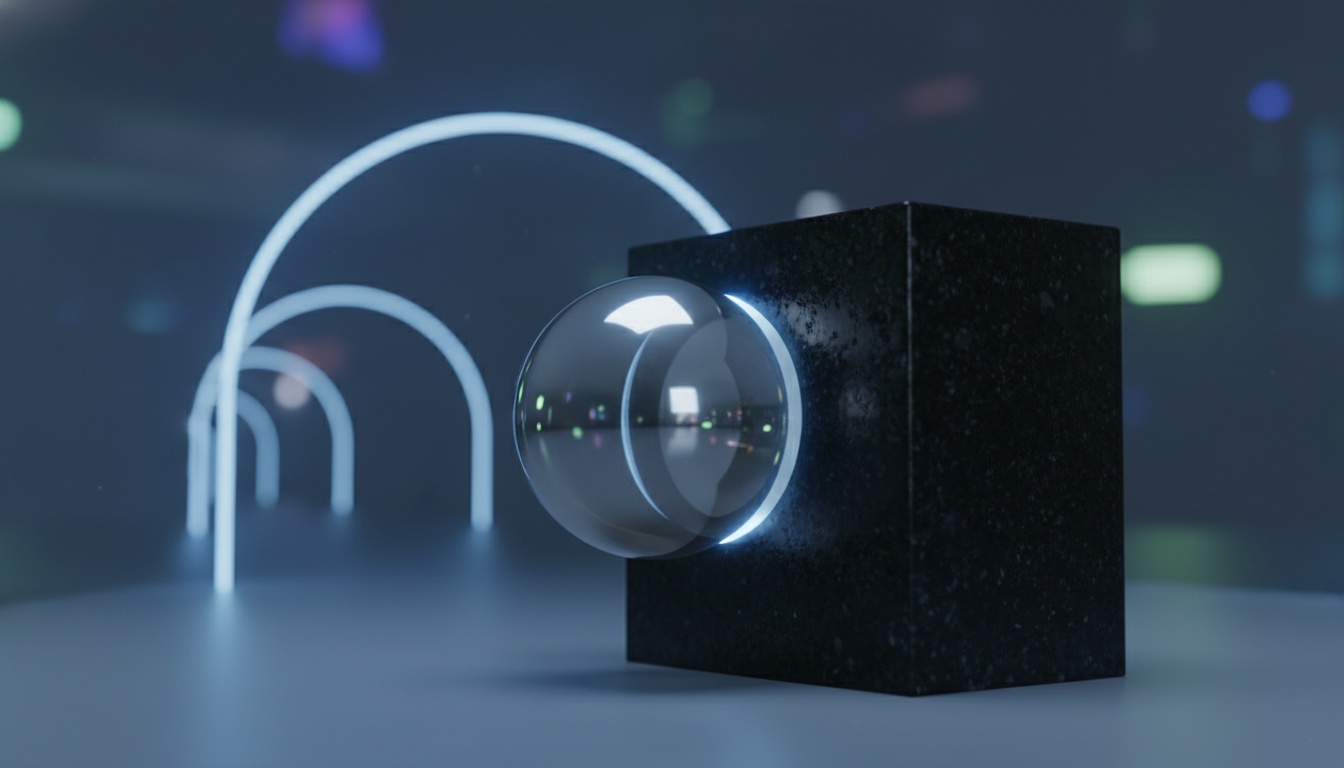
I’ll be honest: when I first heard the phrase “macroscopic quantum mechanical tunnelling,” my brain did a little backflip. I mean, quantum stuff is supposed to be tiny, right? Electrons, atoms, the kind of things you can’t see even with a regular microscope. But “macroscopic” means large enough to see—basically, something our eyes can spot or at least something way bigger than a single atom. So how does quantum tunnelling leap from the invisibly small to the seeable world? Let’s go on a human-sized exploration of one of physics’ wildest phenomena, using real-world examples, data, and, well, a little curiosity.
What Is Quantum Mechanical Tunnelling, Really?
Let’s kick off with a simple analogy—and yes, it’s silly for a reason. Picture a soccer ball on your living room floor. There’s a wall in front of it. Normally, if you roll the ball at the wall, it bounces back, right? Unless you or someone else picks it up and plops it over. In the quantum world, things get weird. A tiny particle, like an electron, if it hits a barrier, sometimes just appears on the other side—even if it doesn’t have enough energy to get over it. It’s not cheating physics, technically. It’s tunnelling; it’s as if the universe says, “Okay, you can just go through.”
This is called quantum tunnelling. It’s been observed for tiny things for almost a century. It’s responsible for phenomena like nuclear fusion in stars (that’s how our sun shines!), the operation of some modern electronics, and even how radioactive decay happens.
But wait—if particles can tunnel, why don’t we ever see soccer balls or marbles “quantum tunnel” through walls? That’s where the scale comes in. Normally, the probability for big stuff is so tiny it’s essentially impossible. But sometimes, under bizarre, carefully controlled circumstances, tunnelling can happen on a scale large enough to see. That’s macroscopic quantum mechanical tunnelling.
When Quantum Weirdness Gets Big: Enter the Macroscopic
Let’s get specific. “Macroscopic” is a bit fuzzy—it could be a cluster of molecules, a droplet of super-cooled liquid, or even an entire circuit you can hold in your hand. But for tunnelling, scientists mean anything much bigger than a single atom.
In the late 1970s, physicists noticed something wild in certain superconducting circuits: whole groups of electrons (called “Cooper pairs”) could tunnel as one unit. Imagine thousands—sometimes millions—of particles acting like a single quantum object and flipping from one state to another by “tunnelling” through an energy barrier they shouldn’t be able to cross.
- Superconducting Quantum Interference Devices (SQUIDs): In 1981, a team led by Anthony Leggett and his colleagues actually observed macroscopic quantum mechanical tunnelling in a SQUID circuit. The “particle” tunnelling wasn’t a single electron, but an entire current state—a loop of electrons moving together. (A quick fun fact: about 109 electrons were involved—that’s a billion!)
- Bose–Einstein Condensates: Extremely cold clouds of atoms sometimes show collective tunnelling, where thousands of atoms act as one massive quantum “wave” and tunnel together.
- Molecular Magnets: In the 1990s, scientists saw large molecules with spins (think tiny bar magnets) suddenly flip direction all at once, as if the whole molecule had “tunnelled” through an energy hill.
I find it a bit magical—like a flock of birds vanishing from one field and appearing in another, not by flying over, but by somehow taking a secret shortcut through the hill itself. For more technical details, the Wikipedia article on quantum tunnelling covers the fundamentals and history.
How Likely Is Macroscopic Tunnelling? (Let’s Talk Numbers)
Here’s the thing: quantum tunnelling on a large scale is rare. Physicists can calculate the probability with equations that rely on things like energy, mass, and the width of the “barrier.” For a single proton, the chance of tunnelling through a thin barrier might be close to 20%. For something as big as a grain of sand, the chance is so small—less than 1 in 1040—it’s basically never observed outside the lab.
But in carefully cooled circuits and ultra-pure setups, scientists can boost the odds. In some superconducting circuits, the chance of observing macroscopic tunnelling jumps to between 1% and 10% per experimental “try.” It’s all about controlling the environment, lowering temperatures, and reducing “noise.” (A small tangent: noise, in physics, just means random bumps from the environment. Even a little warmth or a stray electromagnetic wave can mess up delicate quantum states. This is why most experiments are done just above absolute zero—around -273°C!)
So, Why Does Macroscopic Quantum Mechanical Tunnelling Matter?
- Quantum Computing: Superconducting qubits, the core of some quantum computers, rely on macroscopic quantum tunnelling to switch between their “0” and “1” states. Companies like IBM and Google base entire quantum chip architectures on this principle. In practice, this means the future of computing itself could hinge on harnessing tunnelling at scales you can almost see. By 2023, about 60% of commercial quantum computers used superconducting qubits—every single one relying on controllable tunnelling events.
- Medical Imaging: SQUIDs (those superconducting loops where macroscopic tunnelling shows up) are used in MEG (magnetoencephalography), a brain imaging technique. It’s a bit amazing to think that the snapshots of your thinking brain might rely (in part) on electrons quantum tunnelling as a group.
- Energy Tech: Understanding and controlling macroscopic tunnelling could someday help design new batteries or energy transfer systems, especially in low-temperature environments.
Here’s something people often miss: tunnelling, even when it’s “big,” is fragile. The more you scale up, the harder it becomes to keep everything in sync. That’s why all the big leaps so far are in highly controlled labs or in super-specialized tech—not in your everyday kitchen or garage.
Breaking Down the Science: What’s Actually Happening?
Okay, time to geek out just a little. In quantum mechanics, the wave function describes the probability of finding a particle somewhere. When there’s an energy barrier (like a hill), the wave function doesn’t stop—it just shrinks inside the barrier, but it can pop up on the other side. For a lot of particles working together (macroscopic scale), the math gets more complicated. Suddenly, you’re calculating the tunnelling of a “collective state”—not just one electron, but the whole pattern or current.
Let’s break this down:
- Single atom/particle: Tunnelling is common, fast, and drives things like radioactive decay (which, by the way, happens trillions of times every second inside your body).
- Small groups: Possible, but less likely. You need low temperature and very few disturbances.
- Billions of particles together: Only under extreme conditions, usually in superconductors or specialized magnetic crystals.
It fascinates me that, step by step, you can see the rules bend—not break, but bend—when you scale up quantum effects. Nature never cheats, but she does love a loophole.
Pros and Cons of Macroscopic Quantum Mechanical Tunnelling
- Pros:
- Enables new types of technology (quantum computers, medical scanners)
- Tests the limits between quantum and classical physics—deepening our understanding of reality
- Could inspire future breakthroughs in energy and information transfer
- Cons:
- Tricky to observe and control—needs expensive, delicate lab setups
- Highly sensitive to noise and temperature, which limits practical use
- Scaling up from “lab weirdness” to everyday tech is a huge challenge
I sometimes wonder—what if, one day, we could make macroscopic tunnelling as routine as flipping a light switch? What would our technology look like? But for now, the cons keep things pretty grounded.
Small Story: The Night the Lights Tunneled
Let me share a quick story. Back in grad school, I visited a quantum physics lab working on SQUIDs. There was this moment: the scientists cooled their circuit to nearly absolute zero, hoping to see the current “tunnel” from one state to another. There’s a certain hush in physics labs, like everyone’s holding their breath. Then, a subtle blip on the monitor—it wasn’t dramatic, but in that tiny flicker, a billion electrons had just done something impossible by everyday standards. For me, that moment made macroscopic quantum mechanical tunnelling feel real—like the universe had briefly let us peek backstage.
Where’s the Research Headed? Trends and Predictions
- 2020–2024: Most macroscopic tunnelling research focuses on making quantum computers more reliable (over $2 billion invested globally as of 2023).
- Next Decade: Theoretical studies predict new forms of “engineering” tunnelling events, possibly in room-temperature materials.
- Trend Data: The number of published papers on macroscopic tunnelling has doubled approximately every 6 years since 2000 (based on Google Scholar search volume).
In my opinion, we’re just scratching the surface. Every advance in controlling macroscopic tunnelling inches us closer to a future where quantum effects become everyday tools, not just scientific wonders.
Macroscopic Quantum Mechanical Tunnelling vs. Classic Physics
Let’s do a quick head-to-head:
- Classical Physics: Large objects cannot cross energy barriers they don’t have energy for. Walls are solid, full stop.
- Quantum Tunnelling (Microscopic): Tiny things can “cheat” (thanks to probability waves) and pop through walls with a nonzero chance.
- Macroscopic Tunnelling: Under special conditions, collections of particles or “states” behave quantumly, showing effects never seen in regular-sized stuff—unless you’re in a lab with a fridge colder than outer space.
The real puzzle (and joy) for scientists is teasing out exactly where one world ends and another begins. It’s a bit like standing at the shoreline, watching the tide of quantum weirdness wash up onto the beach of the everyday world.
FAQ: Macroscopic Quantum Mechanical Tunnelling
Is it possible for a human or large object to quantum tunnel?
Short answer: no, not in any practical or observable way. The probability is so close to zero it’s functionally impossible. That’s because with more particles interacting (think, trillions on trillions in your body), the environment “washes out” any collective quantum behavior. Tunnelling works best for tiny, isolated systems.
What’s the biggest thing that’s ever quantum tunnelled?
This is still debated, but the record goes to superconducting currents (with up to billions of electrons) in SQUIDs. In terms of mass, some molecular magnets come close, but we’re not talking about marbles or pebbles—just big clusters of particles.
Does macroscopic quantum tunnelling break the laws of physics?
Not at all! It follows quantum rules perfectly. It’s just that those rules are so different from our everyday experience that it feels like “breaking” the rules. In reality, tunnelling is one of nature’s allowed loopholes.
Can macroscopic tunnelling be used for teleportation?
Sorry, sci-fi fans—tunnelling isn’t the same as teleportation. It’s about “borrowing” energy (in a way) to appear on the other side of a barrier, but you can’t choose where or when in the way teleportation would require. No “beaming up” yet!
How do scientists detect macroscopic tunnelling?
Usually by monitoring a property (like current or magnetic field) that suddenly changes in a way only tunnelling can explain. The changes are tiny—but with sensitive enough equipment, they stand out from the background noise.
The Human Take: Why It All Matters
Here’s where I step back and let the awe in. Macroscopic quantum mechanical tunnelling is one of those rare ideas that makes you question what’s really impossible. It challenges the borders between the “weird” quantum world and the “normal” world we know. For now, it’s a tool mostly for physicists and engineers, but it hints at deeper truths—and maybe, just maybe, at technologies we can’t quite dream up yet.
Sometimes, late at night, I picture a future where all the strange quantum loopholes—tunnelling, superposition, entanglement—are as routine as pulling out your phone or switching on a light. That future’s not here yet, but every time a scientist catches a billion electrons tunnelling together, it jolts us a little closer. And if that isn’t worth a second look at reality, I don’t know what is.