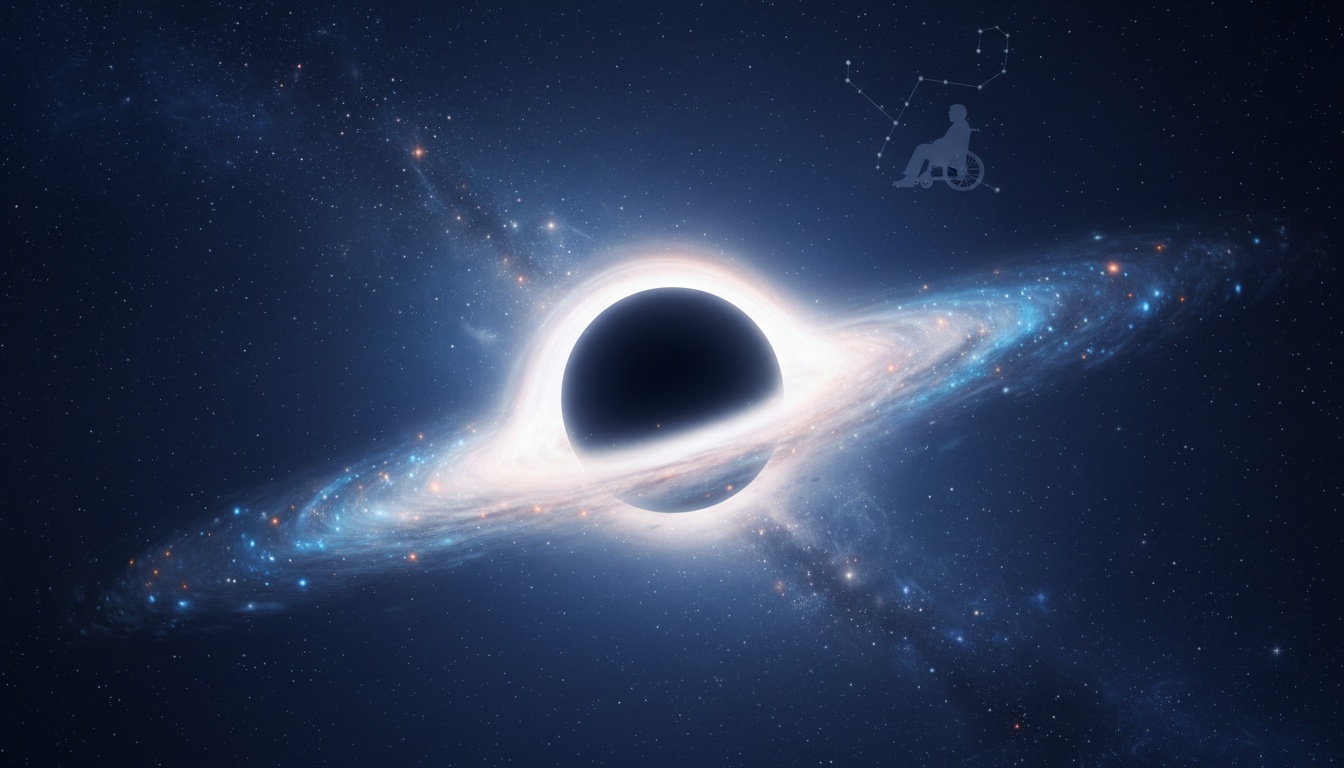
Black holes are some of the most mysterious creatures in the universe. When I first read about them, I pictured these gigantic cosmic vacuum cleaners sucking up everything in their path and never giving anything back. But then, along came a guy named Stephen Hawking who turned the whole idea on its head—and, in the process, gave us the concept of Hawking radiation and black hole evaporation. It’s one of those mind-bending stories where the truth is stranger—and way cooler—than fiction. Let’s explore how black holes are not just one-way traps, but actually leaky, evaporating, and full of surprises.
The Classic View: What Did We Think Black Holes Were?
Let’s set the stage. Before the 1970s, black holes were basically imagined as cosmic prisons. Anything—light, matter, unlucky space explorers—that crossed the event horizon (think of it as the ultimate do-not-cross line) was lost forever. It couldn’t escape. You can try to imagine it: a region so dense and so powerful that not even light, the fastest thing in the universe, can break out. The “hole” part is actually a bit misleading—it’s not a hole in the sense of a tunnel, but a place where matter is so squished it changes the rules of physics.
Back then, the logic was simple: Once something’s in, it’s in for good. Black holes never shrink. If anything, they just get bigger as they gobble up more stuff. The idea of a black hole losing mass? That was like suggesting your cookie jar might lose cookies if you just leave it alone on the kitchen counter. Impossible, right?
Quantum Physics Crashes the Party
Here’s where things get wild. In 1974, Stephen Hawking—yes, that Stephen Hawking—used the weirdness of quantum mechanics to flip everything upside down. See, the universe is not quiet, even in “empty” space. Thanks to quantum physics, there’s this non-stop jitter of energy and particles popping in and out of existence everywhere. Even right now, between your hands as you read this, there are pairs of particles blinking in and out of reality faster than you can blink.
Most of the time, these particle pairs (one positive, one negative) just annihilate each other and disappear before anyone notices. But near a black hole’s event horizon, something different can happen: One particle falls in, the other escapes. The one that gets away—poof!—is seen as Hawking radiation. The black hole loses just a tiny smidge of its mass for every escaping particle.
How Does Hawking Radiation Actually Work? (Let’s Break It Down)
Alright, let’s slow down and walk through this step by step—because it truly is one of those “wait, what?” moments in science.
- Virtual particles are everywhere: Space isn’t empty. Due to quantum fluctuations, pairs of particles and antiparticles are constantly being born and then instantly rejoining (annihilating) each other.
- Near the event horizon matters: At the edge of a black hole, if this particle-antiparticle pair pops up exactly on the event horizon, there’s a chance gravity will grab one, sucking it into the black hole.
- One particle escapes, one is trapped: The escaping particle becomes real for an outside observer—it’s Hawking radiation. The trapped one (with negative energy) reduces the black hole’s mass ever so slightly.
- Energy loss over time: Every time this happens, the black hole gets lighter. Slowly, almost unimaginably slowly, the black hole evaporates.
Let me stop here and say: if your brain’s a little knotted, you’re not alone. Even physicists took a while to wrap their heads around this. It connects gravity, thermodynamics, and quantum theory—all famously tricky to blend together. But that’s what made Hawking’s insight so brilliant and, honestly, a bit poetic.
How Fast Do Black Holes Evaporate?
So, if black holes can “evaporate” through Hawking radiation, are they all just vanishing before our eyes? Not exactly. Here’s where the numbers get both hilarious and humbling.
- Big black holes evaporate extremely slowly. A black hole with the mass of our sun would take something like 1067 years to evaporate. That’s a 1 with 67 zeros after it. The current age of the universe? About 13.8 billion (1.38 x 10¹⁰) years. So… yeah, sun-sized black holes aren’t going anywhere soon!
- Small black holes go faster. If you (somehow) had a black hole the mass of a large mountain (say, Mount Everest), it’d evaporate in maybe a trillion years—a blink, cosmically speaking, but still vastly longer than human history.
- Evaporation speeds up at the end. This is wild: As the black hole gets lighter, it actually loses mass faster. The final stage? A final, furious burst of radiation—possibly a huge explosion, almost like a cosmic firework. Think of it as a last, desperate shout before vanishing forever.
Real-World Examples: Have We Ever Seen Hawking Radiation?
Here’s a fun twist: Despite all the theory, no one has directly observed Hawking radiation—yet. The reason is simple. The radiation emitted by normal-sized black holes is colder than the coldest vacuum in space. It’s basically undetectable with our current technology.
But scientists are clever. They’ve built analogues in labs—using clever setups with lasers, sound waves, and water—that mimic how event horizons might work, and some of these systems have produced “Hawking-like” radiation. It’s not quite the real deal, but it’s strong supporting evidence that Hawking’s theory holds water. For a deeper dive, the Wikipedia entry on Hawking radiation is a good place to start.
Why Does This Matter? (The Big Picture)
Let’s zoom out. Why should anyone care about Hawking radiation and black hole evaporation? For me, it’s not just about black holes “shrinking.” This idea sits right at the crossroads of three of the biggest ideas in modern science:
- General Relativity: The physics of big, heavy things—gravity, space, and time itself.
- Quantum Mechanics: The weird, jittery rules of the teeny-tiny (atoms, particles).
- Thermodynamics: How heat, energy, and information move around the universe.
Black holes used to seem like the ultimate exception to the universe’s rules—a place where information disappears. But Hawking’s idea forces us to ask tough questions: Does information really vanish in a black hole? (This is called the “black hole information paradox,” and it’s still hotly debated.) Are black holes just engines that turn mass into energy over eons?
In a way, Hawking radiation is a bridge between the cosmic and the quantum. It hints that everything—even the universe’s wildest monsters—follows the same physical laws, just at different scales and speeds.
Black Hole Thermodynamics: The Universe’s Strangest Heat Engine?
Here’s something people often miss: Thanks to Hawking radiation, black holes actually have a temperature. For a stellar-mass black hole, that temperature is so close to absolute zero it’s laughable. (Imagine a temperature that makes the coldest spot on Earth feel like a sauna.) But it means black holes obey the laws of thermodynamics, just like engines, ice cubes, or your cup of tea.
This idea led to the concept of black hole entropy—a kind of measure of how much “hidden information” is in the black hole. The math shows that the entropy is proportional to the surface area of the event horizon, not the volume. Weird, right? Most things’ entropy depends on their contents, but for black holes, it’s all about the skin, not the stuffing. It’s like saying your secrets are written on your diary’s cover rather than inside the pages.
Pros, Cons, and Big Questions
- Pros:
- Connects quantum mechanics and general relativity—two of science’s greatest pillars.
- Explains a possible fate for black holes billions of years from now.
- Suggests that nothing in the universe is truly permanent—not even black holes.
- Cons (or at least, open puzzles):
- No direct experimental proof in space yet—so it’s still a hypothesis, albeit a very popular one.
- Raises tough questions: Where does the information go? Can quantum theory and gravity ever fully get along?
Sometimes, I wonder if the biggest lesson here is philosophical: that the universe is more interconnected and surprising than we ever imagined. Even the most impenetrable, “eternal” objects have their own life cycle, their own eventual end.
Black Hole Evaporation: What Happens at the End?
Picture a black hole in its final moments. For eons, it’s been shrinking so slowly it’s practically frozen in time. Then, as it gets smaller and smaller, it starts losing mass faster and faster—like an ice cube melting in the sun.
In its last millisecond, the black hole could explode in a flash of energy. Some scientists estimate that the final seconds could release as much energy as a massive nuclear bomb—though, again, this is all out in deep space, likely far from anywhere we’d notice. There’s speculation (though no proof) that small, “primordial” black holes might still be evaporating right now, somewhere in the vast emptiness—maybe even sending out little blips of high-energy radiation we could, someday, detect.
Everyday Parallels: Are Black Holes Like Anything We Know?
Honestly, nothing on Earth is quite like a black hole. But maybe the closest analogy is watching a chunk of dry ice “sublimate”—turning right from solid to gas, seeming to vanish before your eyes. You know the ice is there, then suddenly it’s just gone, leaving a cold mist behind. Black holes evaporating via Hawking radiation is a bit like that, but slower, grander, and infinitely more mysterious. Instead of fog, you get a faint, near-undetectable whisper of energy drifting through the universe.
FAQ: Hawking Radiation and Black Hole Evaporation
Can ordinary black holes evaporate completely?
In theory, yes! Given enough time (far, far longer than the age of the universe so far), even the biggest black holes will eventually radiate all their mass away. For the supermassive ones at the center of galaxies, we’re talking 1,000s of trillions of years.
Has anyone ever detected Hawking radiation directly?
Nope, not yet. The effect is so faint that it’s well below our current detection abilities. But physicists are hopeful that future experiments—maybe with tiny black holes or new types of detectors—could finally catch it in action.
Does Hawking radiation mean black holes aren’t eternal after all?
Exactly. Before Hawking, black holes were thought to last forever (unless they merged or got “eaten” themselves). Now we think they all have an expiration date—even if it’s unimaginably far away.
Is Hawking radiation dangerous?
Not for us! The radiation from a typical black hole is incredibly weak—so much so that it’s practically impossible to notice from across the galaxy. Only in the last moments of a black hole’s life would it give off a big burst of energy, but that’s not something Earth needs to worry about.
Why is the “information paradox” such a big deal?
Great question. If information about what falls into a black hole is truly lost forever, it breaks the rules of quantum physics—which says information is never destroyed. Nobody’s cracked the paradox yet, but solving it could help unite quantum theory and gravity, two theories that just don’t play nicely together (yet).
A Human Reflection: Why This Matters to Me
Sometimes, when I look up at the night sky, I remember that even the most eternal things are changing, however slowly. Hawking radiation and black hole evaporation remind us that the universe is never still, never truly permanent. There’s always a next chapter, a new question, or a hidden process quietly rewriting the rules. We may not see a black hole evaporate in our lifetimes—or even in the next trillion years—but knowing it happens brings a little humility, a little wonder. After all, if black holes can vanish into thin air, maybe some mysteries are waiting for us right here on Earth, if only we’re curious enough to look.